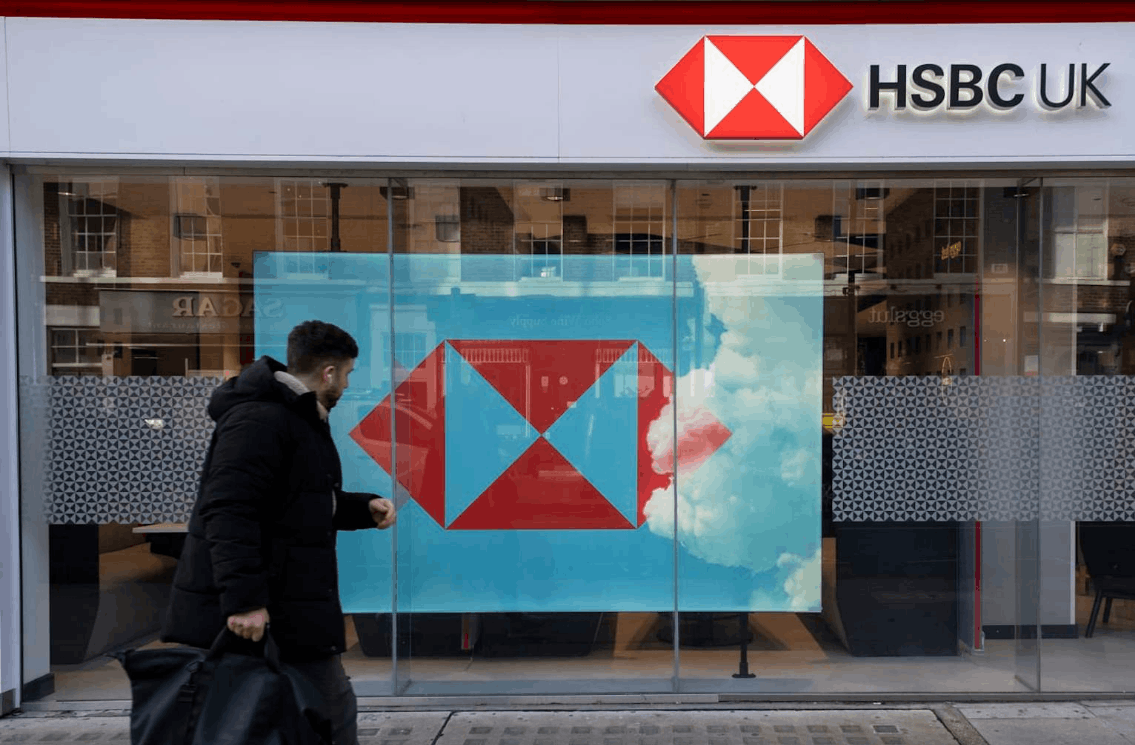
HSBC shares slipped as global investors reacted to fresh tariff threats by Donald Trump targeting major European economies. Thin liquidity in European markets magnified the sell off, raising concerns about broader capital market disruption rather than just trade flows. Analysts believe the impact on stocks may be short lived, but risks around cross border investments and financial stability remain elevated. HSBC is also navigating internal restructuring, adding another layer of uncertainty for shareholders.
Intro: HSBC Holdings plc came under immediate pressure after US President Donald Trump warned of new tariffs on eight European nations, unsettling already fragile global markets. With Wall Street closed, European equities bore the brunt of the reaction, and HSBC shares declined despite the bank’s strong international footprint. Investors are now weighing whether this is a temporary shock or a sign of deeper capital market risks. Beyond geopolitics, HSBC is also reshaping its business strategy, which makes the current moment especially critical for shareholders and global investors.
Latest Update
- HSBC has continued reviewing its international asset portfolio, including insurance and wealth management units, as part of a broader focus on Asia driven growth markets.
- Senior executives have increased engagement with Asian institutional investors, signaling renewed emphasis on long term capital allocation rather than short term market volatility.
- European financial hubs have seen increased investor caution, with banks reassessing exposure to cross-border capital flows amid policy uncertainty.
Why did HSBC shares fall after the Trump tariff announcement?
HSBC shares fell primarily because investors reacted to heightened geopolitical risk triggered by Trump’s tariff threat on European countries. The move increased fears of retaliatory measures and capital flow disruptions. Thin market liquidity amplified the decline, making even moderate selling pressure more visible in stock prices.
The immediate catalyst was Trump’s statement that imports from several European nations could face tariffs starting at 10 percent, with the possibility of rising sharply. While HSBC does not rely solely on European trade, it is deeply integrated into global capital markets. Any disruption to Europe US financial relations directly affects sentiment toward large multinational banks.
Another factor was timing. With US markets closed, European investors had fewer reference points, which often leads to exaggerated price movements. HSBC, being one of the most liquid and widely held banking stocks, became a proxy for broader risk aversion.
Importantly, the decline was not driven by HSBC-specific financial weakness. Instead, it reflected macro uncertainty and investor caution around policy driven shocks.
Read Also: IMF Raises US Growth Forecast to 2.4% as AI Investment Hits Record Levels
Are Trump tariffs more dangerous for capital markets than trade?
Many analysts believe the real danger lies in capital markets rather than trade volumes. Restrictions or pressure on investments, bonds, and equities can create systemic risks that extend far beyond tariffs on goods.
According to Deutsche Bank analysis, European countries hold close to 8 trillion dollars in US bonds and equities. This makes Europe one of the largest external stakeholders in US capital markets. If trade tensions escalate into financial restrictions, the impact could be severe.
Unlike goods trade, capital flows affect currencies, bond yields, and stock market stability. Even subtle policy signals can trigger large scale portfolio rebalancing. Banks like HSBC, which operate across continents, are particularly sensitive to such shifts.
This is why markets reacted quickly. Investors are not just pricing tariffs on exports, but the possibility of a broader financial standoff.
How could Europe respond to US tariff pressure?
Europe has tools that go beyond traditional tariffs, including mechanisms designed to counter economic coercion. These measures could restrict market access or limit financial activities by foreign entities.
The European Union has already discussed activating its anti coercion instrument, often described as a powerful defensive tool. This framework allows coordinated responses if a member state faces economic pressure.
Such responses may include limits on procurement access, regulatory barriers, or financial restrictions. While these steps are usually a last resort, their mere possibility adds uncertainty.
For global banks, this environment complicates planning. Compliance costs rise, cross-border transactions slow, and investor confidence weakens.
Read Also: OpenAI, Anthropic, and SpaceX Prepare for $1.6 Trillion IPO Wave
What does this mean for HSBC’s global strategy?
HSBC’s strategy of focusing on Asia may help cushion some European volatility, but it does not fully insulate the bank from global shocks. Its worldwide exposure remains both a strength and a risk.
HSBC earns a significant share of profits from Hong Kong and mainland China. This geographic diversification has long been its competitive advantage. However, geopolitical tensions can still ripple across regions.
The bank is reviewing assets like HSBC Life Singapore, potentially unlocking over 1 billion dollars in value. This move reflects a sharper focus on core markets with higher growth potential.
Investors will closely watch whether this strategic refocus improves resilience during periods of global stress.
Do analysts expect long-term damage to HSBC shares?
Most analysts view the current pressure as short-term rather than structural. Expectations of stable global growth and easing interest rates support this view.
Strategists from major investment banks suggest that tariff threats often lose impact unless they translate into sustained policy action. Markets tend to reprice risk quickly and then stabilize.
HSBC’s upcoming results will be crucial. Investors want clarity on capital returns, cost discipline, and progress in Asia focused restructuring.
If fundamentals remain strong, short term volatility may present buying opportunities rather than long term losses.
Read Also: IMF and Fitch Warn Fed Interference Could Harm US Credit Rating
How does HSBC compare with other European banks right now?
| Bank | Primary Exposure | Recent Market Reaction | Key Risk Factor |
|---|---|---|---|
| HSBC | Asia and Global | Moderate decline | Geopolitics and capital flows |
| Barclays | UK and US | Limited impact | Investment banking cycles |
| Deutsche Bank | Europe and US | Higher volatility | Market sentiment |
How could capital flows impact global banking stocks?
| Scenario | Impact on Markets | Effect on Banks |
|---|---|---|
| Stable relations | Normal volatility | Steady earnings |
| Trade only dispute | Sector specific pressure | Manageable risk |
| Capital restrictions | High volatility | Systemic stress |
Key Takeaways
- HSBC shares fell due to geopolitical risk, not weak fundamentals.
- Markets fear capital market disruption more than trade tariffs.
- Europe holds significant leverage through US asset ownership.
- HSBC’s Asia focus may provide partial insulation.
- Analysts largely expect short term volatility.
Frequently Asked Questions
Why did HSBC shares fall today?
HSBC shares declined due to investor concerns over new US tariff threats against Europe and the risk of broader capital market disruption.
Are Trump tariffs directly hurting HSBC earnings?
Not directly. The impact is mainly through market sentiment and geopolitical uncertainty rather than immediate earnings damage.
What is the biggest risk from these tariffs?
The largest risk is disruption to global capital flows, which can affect currencies, bonds, and banking stability.
Does Europe have leverage against the US?
Yes. European nations hold trillions in US financial assets, giving them potential influence in any prolonged dispute.
Is HSBC exiting Europe?
No. HSBC is optimizing its portfolio but remains active in Europe while prioritizing Asia.
Should investors worry about long term losses?
Most analysts see the current decline as short-term volatility rather than a long term trend.
When is HSBC’s next major update?
HSBC’s upcoming annual results will provide clarity on strategy, earnings, and capital allocation.
Conclusion
HSBC’s share price decline highlights how sensitive global banks are to geopolitical signals, even when their fundamentals remain intact. Trump’s tariff threat unsettled markets not because of immediate trade losses, but due to fears of deeper capital market conflict. While Europe and the US both hold significant leverage, prolonged uncertainty can weigh on investor confidence. For HSBC, the situation underscores the importance of its strategic pivot toward Asia and disciplined capital management. As markets digest the news, attention will quickly shift back to earnings performance and long-term growth drivers.