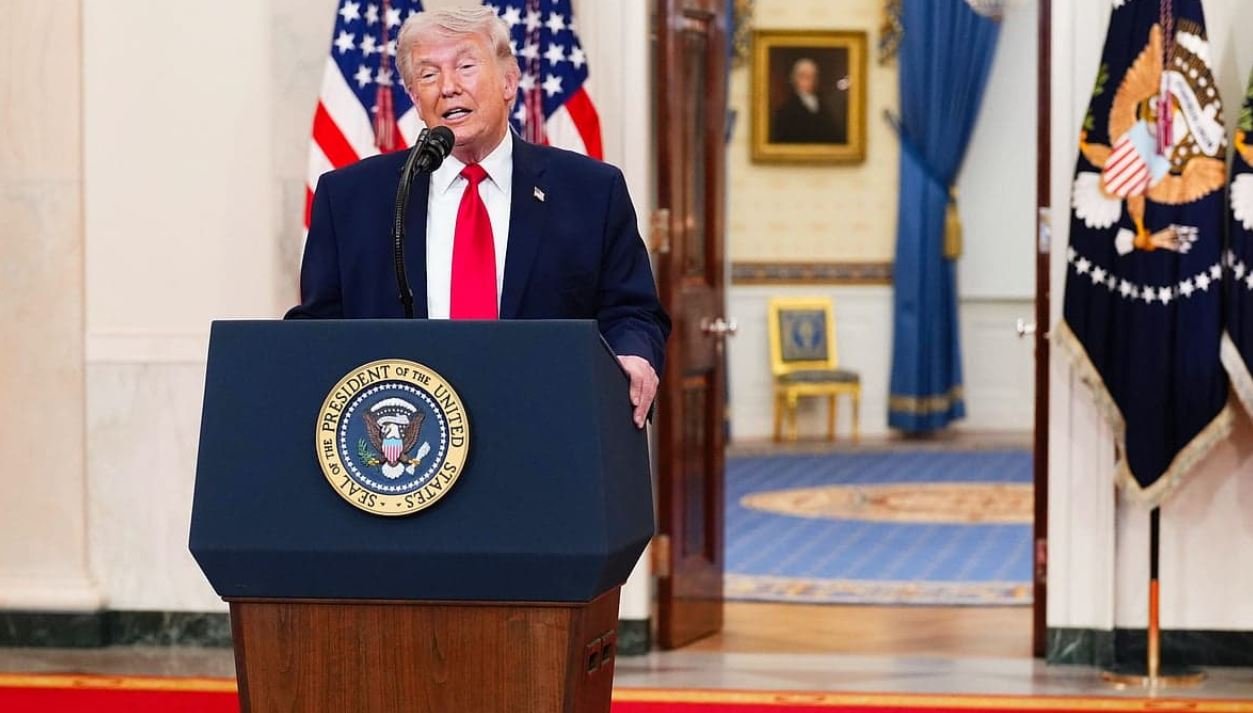
Tensions have reached a breaking point as the Tuesday 8 p.m. EST deadline set by President Donald Trump approaches. Following a series of escalatory threats, Iran has officially rejected an 11th-hour ceasefire proposal, signaling a potential direct military confrontation. The conflict, centered on the blockade of the Strait of Hormuz, now threatens to dismantle Iran’s civilian infrastructure and destabilize the global energy market.
What is the “Bridge Day” ultimatum issued by the U.S.?
The “Bridge Day” ultimatum refers to President Trump’s threat to decimate every bridge and power plant in Iran by midnight Tuesday if the Strait of Hormuz is not reopened. This deadline was set following a profanity-laced social media post where the President claimed “Tuesday will be Power Plant Day, and Bridge Day, all wrapped up in one.” The threat targets the core of Iran’s domestic logistics and energy production.
During a White House press conference, the President detailed a plan to put Iranian power plants “out of business” through a series of coordinated explosions. When questioned about the legality of targeting civilian sites, the administration maintained that these facilities are integral to Iran’s military capabilities. This stance has created a sharp divide between Washington and the international legal community.
The logistics of such a strike would involve a massive deployment of precision-guided munitions. Strategic analysts suggest that destroying the bridge network would not only cripple the Iranian military’s internal movement but also cause a total collapse of food and medical supply chains for the civilian population.
Why is the international community labeling these threats as war crimes?
The international community, led by UN Secretary-General António Guterres, argues that the Geneva Conventions strictly prohibit the targeting of “objects indispensable to the survival of the civilian population.” Bridges and power plants are generally classified as civilian infrastructure. Under the principle of distinction, military forces must differentiate between combatants and civilians, and between military objectives and civilian objects.
Comparison of International Law vs. Strategic Rhetoric
| Legal Principle | International Standard (UN/EU) | U.S. Administration Stance |
| Principle of Distinction | Civilian sites must never be targeted. | Infrastructure supports military aggression. |
| Proportionality | Damage must not exceed military gain. | Total destruction is a necessary deterrent. |
| Humanitarian Access | Bridges are vital for aid and food. | Strategic bottlenecks must be eliminated. |
| Energy Facilities | Protected as essential civilian services. | Valid targets if powering defense systems. |
European Council President António Costa has reinforced that the targeting of energy facilities is “illegal and unacceptable.” The concern is that even if a power plant serves a dual purpose (military and civilian), the “incidental harm” to the civilian population—such as the loss of hospital power and water sanitation—would be vastly disproportionate to the military advantage gained.
How has Iran responded to the Tuesday deadline?
Iran has remained defiant, rejecting the ultimatum and issuing its own warning that “the gates of hell will open” if U.S. strikes commence. Iranian officials view the blockade of the Strait of Hormuz as a sovereign right in response to economic sanctions. Rather than seeking a diplomatic exit, Tehran has doubled down on its defensive posture, moving mobile missile launchers to the coast.
The rejection of the ceasefire indicates that Iran is banking on the international community’s pressure to restrain the U.S., or it is prepared for a “total war” scenario. Domestic sentiment in Iran has shifted toward nationalistic fervor, with state media broadcasting images of military readiness.
This defiance is also a message to regional allies. By standing firm against the midnight deadline, Iran aims to demonstrate that it will not be intimidated by “infrastructure warfare.” However, this leaves little room for de-escalation as the clock ticks toward 8 p.m. EST.
What are the economic consequences of the Strait of Hormuz closure?
The closure of the Strait of Hormuz is a catastrophic event for global trade because it is the world’s most important oil transit chokepoint. Approximately 20 million barrels of oil pass through this narrow waterway daily. The disruption has already led to a 4% drop in related housing sales in markets like India and caused fuel prices to spike globally.
If the conflict escalates to the destruction of Iranian power plants and bridges, the volatility will spread beyond oil. Supply chains for consumer goods, electronics, and food that rely on Middle Eastern logistics will face unprecedented delays. Investors have begun pulling out of emerging markets, seeking safety in gold and the U.S. dollar, though even the dollar is seeing pressure due to the threat of war.
- Crude Oil Prices: Expected to exceed $150 per barrel if hostilities begin.
- Insurance Premiums: Maritime insurance for shipping in the Gulf has increased by 500%.
- Global Logistics: Shipping companies are rerouting around Africa, adding weeks to delivery times.
- Inflationary Pressure: Higher energy costs are being passed directly to consumers at the pump.
What happens if the Tuesday 8 p.m. deadline passes?
If the deadline passes without the reopening of the Strait, the U.S. military is reportedly prepared to initiate “Operation Bridge Day.” This would involve a mix of cyber-attacks to disable the power grid and kinetic strikes (missiles and bombs) to destroy physical structures. The goal would be to paralyze Iran’s internal economy to force a surrender.
However, military experts warn of a “tit-for-tat” escalation. Iran could retaliate by targeting U.S. bases in Iraq and Qatar, or by using “swarm” boat tactics against U.S. Navy vessels in the Gulf. There is also the significant risk of proxy groups in Lebanon and Yemen opening new fronts in the conflict.
The most immediate domestic result in the U.S. would be a massive political debate over the War Powers Act. Since a formal declaration of war has not been issued, any strike on civilian infrastructure would likely face immediate challenges in both the halls of Congress and the International Criminal Court.
In Short: Key Takeaways
- Deadline: Tuesday 8 p.m. EST is the cutoff for Iran to reopen the Strait of Hormuz.
- Targets: Every major bridge and power plant in Iran is at risk of “decimation.”
- Legal Status: The UN and EU have labeled the proposed strikes as potential war crimes.
- Economic Impact: 20% of the world’s oil supply is currently blocked, causing global market turmoil.
- Diplomacy: Iran has officially rejected a ceasefire, opting for military readiness.
- Military Stance: The U.S. claims infrastructure is a valid target to stop military aggression.
Frequently Asked Questions
Is targeting power plants actually a war crime?
Under the Geneva Conventions, civilian infrastructure is protected. It can only be targeted if it provides a direct military advantage, and even then, the strike must be proportional. Targeting “every” power plant is widely considered illegal by international scholars.
Why is the Strait of Hormuz so important?
It is a narrow waterway between Oman and Iran that connects the Persian Gulf with the Gulf of Oman. It is the primary route for oil exports from Saudi Arabia, Kuwait, the UAE, and Iraq.
What is “Sha Chi” in the context of global tension?
While “Sha Chi” is a Feng Shui term for “killing energy” or “poison arrows,” in modern geopolitical discussions, it is sometimes used metaphorically to describe the aggressive, directed hostility in diplomatic rhetoric that leads to conflict.
Can the UN stop the U.S. from attacking?
The UN can pass resolutions and condemn actions, but it has no standing army to physically prevent a superpower from initiating a strike. Influence is primarily diplomatic and through economic sanctions.
How will this affect gas prices at home?
If the conflict begins, experts predict an immediate jump in gas prices, potentially increasing by $1.00 to $2.00 per gallon within 48 hours as the market reacts to the loss of Iranian and Gulf oil.
What are “dual-use” facilities?
These are infrastructures, like bridges or power grids, that serve both civilians and the military. The U.S. often argues these are valid targets, while international law emphasizes the protection of the civilians who rely on them.
What is Iran’s “Gates of Hell” threat?
It is a rhetorical warning suggesting that Iran will unleash its full military and proxy capabilities, potentially including missile strikes on regional targets and closing global energy corridors indefinitely.
Final Thoughts
The standoff between the U.S. and Iran has moved beyond mere rhetoric into a countdown for a potentially world-altering military engagement. The “Bridge Day” ultimatum highlights a new and controversial doctrine of targeting a nation’s foundational infrastructure to achieve diplomatic goals. While the U.S. seeks to break the blockade of the Strait of Hormuz, the cost may be a total breakdown of international law and a global economic shock. As the Tuesday deadline looms, the world watches with bated breath to see if diplomacy can reclaim the narrative or if the “gates of hell” will indeed open, reshaping the Middle East for generations to come.