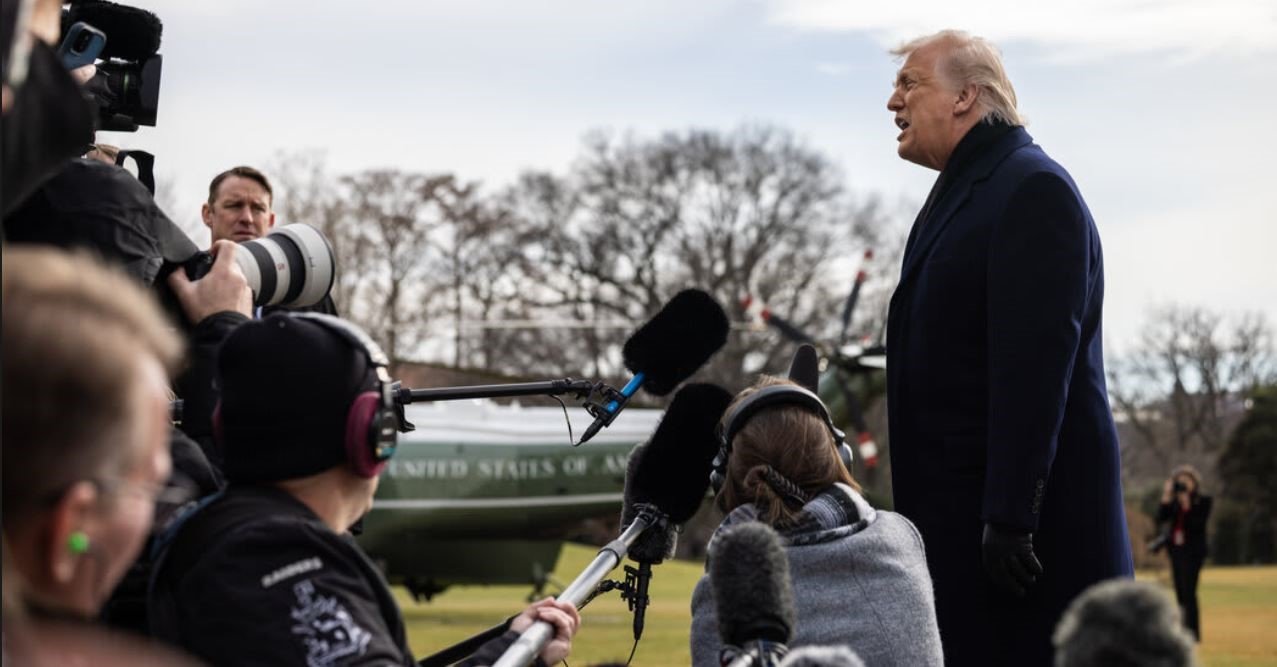
Asian stock markets declined sharply as global investors moved away from risk assets after U.S. President Donald Trump threatened fresh tariffs on European allies over Greenland. The announcement triggered a flight to safety, lifting gold, silver, the yen, and the Swiss franc while pressuring equities across Japan, Hong Kong, Australia, and Singapore. Futures in Europe and the United States also weakened, reflecting broader global uncertainty. South Korea and China stood out as rare exceptions, supported by strong domestic fundamentals.
Introduction
Asian equity markets opened the week under pressure as geopolitical tension returned to the center of global investing. The catalyst was an unexpected escalation in U.S. trade rhetoric, with President Donald Trump linking tariffs on major European economies to demands surrounding Greenland. Investors responded swiftly by cutting exposure to equities and rotating into traditional safe havens.
This shift pushed precious metals to record highs while dragging down stock index futures across major regions. While most Asian markets followed the risk averse tone, a few pockets of resilience emerged, highlighting how domestic fundamentals can still influence outcomes even during global shocks.
Latest Update
- Asian equities weakened broadly as investors reduced exposure to cyclical sectors and export driven stocks. Defensive assets gained favor as uncertainty around trade policy intensified.
- Gold and silver touched record levels as portfolio managers increased allocations to inflation hedges and geopolitical protection. Currency markets reflected similar caution with stronger demand for the yen and Swiss franc.
- South Korean equities moved against the regional trend, supported by strong corporate earnings momentum in autos and semiconductors. Chinese markets also remained steady after economic growth data met official targets.
Why did Asian stocks fall after Trump Greenland tariff threats?
Asian stocks fell because markets interpreted the tariff threats as a shift toward aggressive geopolitical trade policy rather than standard negotiation tactics. This raised fears of supply chain disruption, weaker global trade, and higher input costs for exporters across Asia.
The threat targeted eight European economies with an initial tariff level that could rise sharply if political demands were not met. Even though Asia was not directly named, investors quickly priced in second order effects such as slower European demand for Asian exports and heightened global volatility.
Markets also reacted to the symbolic nature of the move. Linking tariffs to territorial acquisition introduced a new layer of uncertainty that traditional economic models struggle to price. As a result, fund managers chose caution over risk, leading to broad based selling.
Read Also: BlackRock Invests Over $1 Billion in Bitcoin and Ethereum ETFs
How did major Asian markets perform during the selloff?
Most major Asian indices declined as risk appetite weakened, with Japan and Hong Kong leading losses, while Australia and Singapore posted moderate declines.
| Market | Index | Movement |
| Japan | Nikkei 225 | Down about 1.3 percent |
| Japan | Topix | Down about 0.6 percent |
| Hong Kong | Hang Seng | Down about 1 percent |
| Australia | ASX 200 | Down about 0.33 percent |
| Singapore | Straits Times | Down about 0.5 percent |
Japan’s heavy exposure to global trade made it particularly sensitive to tariff related headlines. Technology, industrials, and exporters faced the strongest selling pressure. In contrast, markets with higher domestic demand exposure showed relatively smaller declines.
Why did South Korea and China outperform the region?
South Korea and China outperformed because of strong domestic catalysts that offset global risk aversion, including robust corporate performance and stable economic growth data.
South Korea’s Kospi extended its winning streak as investors chased momentum in autos and semiconductors. Hyundai Motor and Kia surged after reporting record combined market share in the United States, reinforcing confidence in earnings resilience despite global uncertainty.
Chinese equities found support after official data confirmed the economy met its growth target. While quarterly growth moderated, it exceeded expectations, reassuring investors that policy support remains effective. This stability helped the Shanghai Composite edge higher while regional peers declined.
Read Also: Global Investors Shift Away from US Tech Giants as International Markets Gain Favor
What does the safe haven rally signal about investor sentiment?
The surge in gold, silver, and defensive currencies signals elevated fear and a preference for capital preservation over growth.
| Asset | Investor Role | Market Reaction |
| Gold | Inflation and crisis hedge | Record high demand |
| Silver | Alternative safe asset | Sharp price surge |
| Japanese yen | Defensive currency | Strengthened |
| Swiss franc | Safe haven currency | Strengthened |
Such synchronized moves typically occur when investors perceive systemic risk rather than isolated market events. The reaction suggests markets are increasingly sensitive to political decisions that can disrupt trade flows and corporate planning.
How could Trump tariff policy reshape global trade dynamics?
Trump tariff policy could redefine tariffs as geopolitical pressure tools, increasing uncertainty and volatility in global trade relationships.
Analysts noted that the threat blurred the line between economic negotiation and political coercion. European leaders condemned the move, with discussions of retaliatory measures under existing trade defense frameworks.
For Asian economies, the risk lies in indirect exposure. Slower European growth or retaliatory tariffs could reduce demand for Asian manufactured goods. Companies may also delay investment decisions, affecting supply chains that stretch across continents.
Read Also: Gold and Silver Retreat from Record Highs as Trump Pauses Tariffs
What should Asian investors watch next?
Investors should monitor diplomatic responses, policy signals from global forums, and corporate earnings guidance.
Upcoming international meetings could clarify whether the tariff threat is a negotiation tactic or a policy commitment. Markets will also track whether European retaliation escalates into a broader trade confrontation.
At the same time, earnings updates from export oriented Asian firms will provide insight into how much risk is already priced in. Currency movements and commodity prices will remain key sentiment indicators.
Key Takeaways
- Asian stocks declined as tariff threats triggered global risk aversion.
- Safe haven assets surged, reflecting heightened geopolitical fear.
- South Korea and China outperformed due to strong domestic fundamentals.
- Trade policy uncertainty remains a major market driver.
Frequently Asked Questions
Why did Asian markets react to tariffs aimed at Europe?
Asian economies are deeply connected to global trade. Tariffs on Europe can indirectly reduce demand for Asian exports and disrupt supply chains.
Which Asian market fell the most?
Japan’s Nikkei 225 saw the sharpest decline due to its high exposure to global trade and exporter heavy index composition.
Why did gold reach record levels?
Gold rose as investors sought safety amid geopolitical uncertainty and fears of trade disruption.
Why did South Korea’s market rise?
Strong gains in auto and semiconductor stocks supported by solid earnings momentum lifted the Kospi.
Did China’s growth data influence markets?
Yes. Meeting official growth targets reassured investors and helped stabilize Chinese equities.
Are these tariffs confirmed?
The tariffs were announced as conditional threats, leaving room for negotiation and policy reversal.
What sectors are most at risk?
Export driven sectors such as autos, electronics, and industrial manufacturing face the highest exposure.
How long could market volatility last?
Volatility may persist until there is clarity on diplomatic outcomes and trade policy direction.
Conclusion
The sharp decline in Asian stocks underscores how sensitive global markets remain to political signals from major economies. Trump’s Greenland linked tariff threat acted as a catalyst for widespread risk reduction, lifting safe haven assets while pressuring equities. Yet the resilience of South Korea and China shows that strong domestic fundamentals can still provide insulation during global shocks. For investors, the episode highlights the importance of diversification, close monitoring of geopolitical developments, and a balanced approach between growth and defensive assets. As trade policy continues to intersect with geopolitics, market reactions are likely to remain swift and significant.