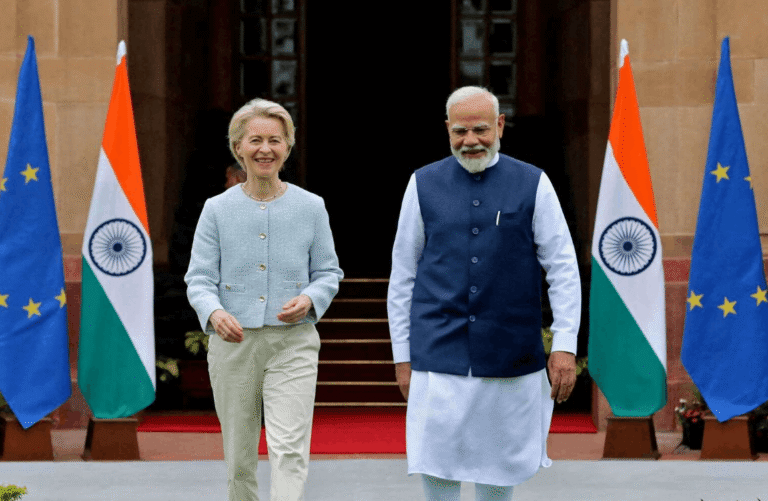
India and the European Union are expected to announce a trade deal within days, offering crucial tariff relief to Indian apparel and textile exporters hit by steep US duties. The agreement could eliminate EU import tariffs, helping exporters offset losses caused by a combined 50% US levy. Industry bodies warn that without rapid trade solutions, factory closures and job losses could accelerate. The EU deal is seen as an immediate lifeline while India seeks longer term resolution with Washington.
The Indian textile and apparel sector is facing one of its most challenging moments in recent years. With the United States imposing a combined 50% tariff on Indian textile imports, exporters are grappling with cancelled orders, shrinking margins, and rising uncertainty. Against this backdrop, a fast-approaching India-EU trade deal has emerged as a potential stabilizer, offering tariff-free access to one of the world’s largest consumer markets. As policymakers signal progress and exporters adjust strategies, the stakes are high for a labor-intensive industry that employs millions.
Latest Update
- India and the European Union are expected to announce a trade agreement shortly, with officials signaling zero-tariff access for apparel and textile exports into the EU market. Industry participants see this as a critical counterbalance to US trade pressure.
- Textile exporters report that US buyers are delaying or cancelling orders due to tariff uncertainty, forcing Indian firms to absorb significant price cuts to retain relationships.
- Government data shows Indian garment exports have remained stable overall, supported by diversification efforts and steady demand from Europe and other non US markets.
- Industry bodies are urging interim relief measures while formal trade negotiations with the United States continue, warning that prolonged delays could cause permanent damage.
Why is the India EU trade deal critical for the textile and apparel industry?
The India EU trade deal is critical because it can immediately remove import tariffs on Indian textiles in Europe, improving competitiveness and offsetting losses from the US market. For exporters facing margin erosion and order cancellations, tariff-free access to the EU offers stability, diversification, and revenue continuity. It also strengthens India’s position in global apparel supply chains.
The European Union represents one of the largest and most stable apparel consumption markets globally. For Indian exporters, EU tariffs currently range between 8% and 12%, which directly affect pricing competitiveness against rivals like Bangladesh and Vietnam. Eliminating these duties could significantly improve order flows.
The deal also carries strategic importance. With the US accounting for nearly 70% of exports for some Indian garment firms, over reliance has exposed structural vulnerabilities. The EU agreement enables diversification without the multi year onboarding delays seen in new markets.
Key benefits include:
- Zero duty access for garments, home textiles, and select technical textiles.
- Improved price competitiveness against regional peers.
- Greater supply chain confidence for European buyers.
- Support for employment in a labor-intensive sector.
Read Also: Trump Drops French Wine Tariff Threat After Davos Talks
Why did the US impose a 50% tariff on Indian textiles?
The United States has implemented a two tier tariff structure on Indian textiles consisting of a 25% base reciprocal tariff and an additional 25% oil related penalty. This secondary penalty is a direct result of India’s continued purchase of crude oil from Russia despite Western sanctions. Combined, these duties make Indian textiles 50% more expensive for US importers, leading to widespread order cancellations.
This aggressive trade stance has created a crisis for exporters who rely on the US for up to 70% of their total revenue. The AEPC has expressed that the industry no longer has any “shock absorption capacity” left. Many firms have already burned through their cash reserves by offering 25% discounts to buyers just to keep factories running. However, continuing this practice is commercially impossible in the long term.
The table below illustrates the current tariff breakdown facing various Indian export categories in the US market as of early 2026.
US Tariff Structure on Indian Goods (2026)
| Product Category | Base Tariff | Oil Related Penalty | Total Tariff Burden |
|---|---|---|---|
| Textiles and Apparel | 25% | 25% | 50% |
| Leather and Footwear | 25% | 25% | 50% |
| Marine Products | 25% | 25% | 50% |
| Chemicals (Organic) | 25% | 25% | 50% |
| Pharmaceuticals | Exempt | Exempt | 0% |
Read Also: European Gas Prices Hit Seven Month High as Cold Snap Drains Storage
How have US tariffs disrupted Indian textile exports?
US tariffs have disrupted Indian textile exports by raising landed costs by up to 50%, triggering order cancellations and forcing exporters to absorb losses. Many firms report wiped-out profits, frozen shipments, and cash flow stress, especially those heavily dependent on the US market.
The combined US tariff includes a 25% base duty and an additional 25% oil related penalty linked to India’s crude oil purchases from Russia. This sudden escalation has created uncertainty for buyers who are unwilling to risk mid-cycle cost changes.
Exporters have responded by offering steep discounts equivalent to the penalty portion, but this strategy is unsustainable. Fixed costs such as wages and compliance expenses leave little room for further absorption.
| Impact Area | Before Tariffs | After Tariffs |
|---|---|---|
| Average export margin | 8% to 10% | Near zero or negative |
| Order visibility | 6 to 9 months | Uncertain or cancelled |
| Cash reserves | Stable | Rapidly depleting |
What is the Apparel Export Promotion Council warning about?
The Apparel Export Promotion Council warns that delays in resolving US tariff issues could cause permanent damage to India’s textile sector. It highlights risks of factory shutdowns, job losses, and loss of global market share if immediate relief is not provided.
In its communication to the government, AEPC emphasized the structural rigidity of the textile industry. With four months of work in progress and six month product development cycles, exporters cannot pivot quickly.
Wages account for nearly 30% of operating costs, making prolonged demand shocks especially damaging. The council has called for either fast tracking a bilateral tariff treaty with the US or providing interim fiscal relief.
Key AEPC concerns include:
- Irreversible buyer migration to competing countries.
- Loss of skilled workforce due to layoffs.
- Erosion of India’s credibility as a reliable supplier.
Read Also: Citigroup Downgrades European Stocks as US Greenland Tensions
Can the EU market realistically replace lost US demand?
The EU market cannot fully replace US demand in the short term, but it can significantly cushion the impact. Tariff-free access can redirect orders, stabilize volumes, and reduce dependence on a single market.
Europe has different sourcing patterns and compliance standards compared to the US. However, many Indian exporters already meet EU sustainability and labor norms, enabling quicker scaling.
| Market | Tariff Level | Buyer Stability | Growth Potential |
|---|---|---|---|
| United States | Up to 50% | Low | Constrained |
| European Union | 0% post deal | High | Moderate to High |
| Other Asia | 5% to 10% | Medium | Long term |
How are exporters adapting through diversification?
Exporters are diversifying by targeting EU retailers, expanding sustainable product lines, and reducing exposure to the US. While diversification takes time, some firms are already securing alternative orders.
At major trade fairs, Indian firms are showcasing eco-friendly products, recycled fabrics, and value-added apparel. Companies like Kolkata-based manufacturers are doubling capacity for sustainable bags aimed at European supermarkets.
However, diversification is not a quick fix. Buyer onboarding, audits, and compliance checks can take 2 to 3 years. The EU deal shortens this timeline by removing tariff barriers for already approved suppliers.
What does this mean for employment and factory operations?
The trade deal could protect millions of jobs by stabilizing factory utilization and order flows. Without relief, prolonged tariff pressure risks widespread layoffs and closures.
The textile industry is India’s second-largest employer after agriculture. Even minor demand disruptions ripple across spinning mills, garment units, logistics providers, and ancillary services.
Factories operate on thin margins and rely on continuous throughput. Sudden order drops quickly translate into reduced shifts and contract labor layoffs.
Read Also: Seven Top Indian CEOs to Meet Donald Trump at Davos Reception
What role does government policy play at this stage?
Government policy is central to mitigating the crisis through trade diplomacy, interim relief, and export support measures. Swift execution is as important as negotiation.
Beyond trade agreements, exporters are seeking temporary measures such as interest subvention, faster refunds, and logistics support. These can help bridge the gap until market conditions normalize.
The EU deal also sends a signal to global buyers that India remains proactive and reliable despite geopolitical turbulence.
Key Takeaways
- India and the EU are poised to announce a trade deal offering zero-tariff access for textiles.
- US tariffs have triggered order cancellations and margin erosion for Indian exporters.
- The EU agreement provides immediate diversification and stability.
- Industry bodies warn of job losses without swift relief.
- Policy speed and execution will determine long-term outcomes.
Frequently Asked Questions
When will the India EU trade deal be announced?
The trade deal is expected to be announced within days, according to government signals, pending final formalities.
Will the EU deal remove all textile tariffs?
Yes, most apparel and textile products are expected to receive zero tariff access under the agreement.
Why did the US impose a 50% tariff on Indian textiles?
The tariff includes a base duty and an additional oil related penalty linked to India’s crude oil imports from Russia.
How dependent is India on the US textile market?
For some exporters, the US accounts for nearly 70% of total textile and garment exports.
Can exporters pass on tariff costs to buyers?
No, buyers are resisting price increases, forcing exporters to absorb costs or lose orders.
How long does market diversification take?
Developing new markets typically takes 2 to 3 years due to audits and compliance requirements.
What happens if no interim relief is provided?
Industry bodies warn of factory closures, layoffs, and permanent loss of export market share.
Does the EU deal help small exporters?
Yes, tariff removal benefits both large and small exporters by improving price competitiveness.
Will this deal impact employment?
Positive impact is expected as stable orders help protect millions of textile jobs.
Conclusion
The impending India-EU trade deal comes at a decisive moment for the country’s textile and apparel industry. With US tariffs straining margins and confidence, tariff-free access to the European market offers a vital stabilizing force. While it cannot fully replace the scale of US demand overnight, it provides exporters with breathing room, supports employment, and reinforces India’s global trade credibility. The coming days will test how effectively policy momentum translates into on-ground relief, shaping the sector’s resilience in an increasingly fragmented global trade environment.