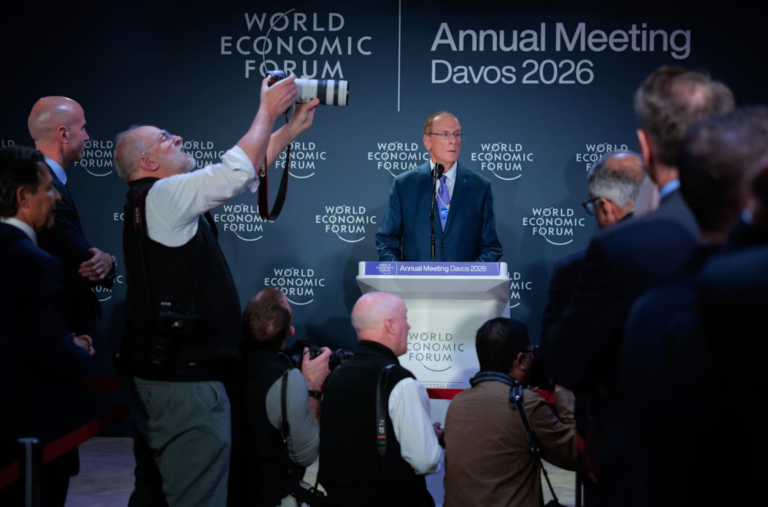
BlackRock CEO Larry Fink has declared blockchain-based finance necessary for the future of global capital markets. Speaking at the World Economic Forum in Davos, he argued that tokenized investments can lower costs, increase transparency, and expand access to financial assets worldwide. Fink believes a shared blockchain infrastructure would make markets more secure while reducing corruption and inefficiencies. His remarks signal that blockchain is moving from experimentation to core financial infrastructure.
The endorsement of blockchain by the world’s largest asset manager marks a turning point for digital finance. Once viewed as speculative or niche, tokenization is now being framed as essential plumbing for modern markets. With major banks, stock exchanges, and regulators entering the conversation, blockchain-based finance is rapidly becoming a mainstream priority rather than a future possibility.
Latest Update
- BlackRock continues to expand its tokenized fund operations across multiple blockchain networks, reinforcing its commitment to digital asset infrastructure. The firm is also exploring additional institutional use cases beyond cash management.
- Major global exchanges are accelerating plans for round-the-clock trading platforms using tokenized securities and instant settlement systems. These initiatives aim to reduce settlement risk and operational friction.
- Regulators in emerging economies are advancing digital currency and asset tokenization pilots faster than developed markets. This shift is increasing pressure on Western policymakers to clarify crypto market rules.
- Traditional banks are increasing investments in blockchain talent and infrastructure as client demand for tokenized products grows. Internal pilots are now moving toward commercial-scale deployment.
Why does Larry Fink say blockchain-based finance is necessary?
Larry Fink believes blockchain-based finance is necessary because it can dramatically reduce fees, improve transparency, and widen access to investment opportunities. According to him, current financial systems rely on layers of intermediaries that raise costs and slow transactions. A unified blockchain platform could streamline these processes while improving security and accountability.
Fink’s argument centers on efficiency and trust. Today’s capital markets involve custodians, clearing houses, brokers, and reconciliation processes that add friction. Blockchain technology allows assets to be issued, traded, and settled on a shared ledger. This reduces duplication of work and lowers operational risk.
He also emphasized democratization. Lower fees make investing accessible to a broader population, especially in emerging markets. Tokenized assets can be divided into smaller units, enabling fractional ownership of traditionally expensive investments.
Finally, Fink highlighted accountability. Every transaction on a blockchain is recorded and auditable. This creates a permanent trail that can deter corruption and fraud. In his view, these combined benefits make blockchain not optional but inevitable for global finance.
Read Also: European Gas Prices Hit Seven-Month High as Cold Snap Drains Storage
What is tokenization, and how does it change investing?
Tokenization is the process of representing real-world financial assets as digital tokens on a blockchain. These tokens can be traded, settled, and owned directly on a digital ledger. Tokenization changes investing by making assets more liquid, accessible, and efficient.
Traditional assets such as stocks, bonds, real estate funds, or money market instruments can be tokenized. Once issued as tokens, they can move instantly between buyers and sellers without waiting days for settlement.
Tokenization also enables fractional ownership. Investors no longer need large sums to access high-value assets. This is particularly relevant for younger investors and those in developing economies.
Another change is operational. Smart contracts can automate compliance, dividend payments, and corporate actions. This reduces manual intervention and errors.
| Feature | Traditional Assets | Tokenized Assets |
|---|---|---|
| Settlement Time | 2 to 3 days | Near instant |
| Minimum Investment | High | Low through fractional units |
| Transparency | Limited | High with on-chain records |
How is Wall Street aligning behind blockchain finance?
Wall Street leaders are increasingly aligning behind blockchain finance as infrastructure rather than speculation. Executives from major banks and exchanges now see blockchain as a foundation for future market operations. This marks a clear shift from earlier skepticism.
UBS CEO Sergio Ermotti recently described blockchain as the future of traditional banking. His statement reflects a broader reassessment among financial institutions that once treated blockchain defensively.
Stock exchanges are also moving. Plans for tokenized securities trading platforms with continuous operation show how core market functions are being redesigned. Instant settlement reduces counterparty risk and capital lockups.
Custodian banks such as Bank of New York Mellon and global lenders like Citigroup are participating in these initiatives. Their involvement signals institutional confidence in blockchain infrastructure.
Read Also: Seven Top Indian CEOs to Meet Donald Trump at Davos Reception
What role does BlackRock’s BUIDL fund play in this shift?
BlackRock’s BUIDL fund serves as a real-world example of tokenization at an institutional scale. It demonstrates how blockchain can support regulated, yield-bearing financial products. The fund validates that tokenization can work within existing compliance frameworks.
The BUIDL fund represents tokenized exposure to short-term US dollar assets. Investors hold digital tokens that reflect their share of the fund.
Its rapid growth shows strong demand from institutions seeking blockchain native liquidity management tools. Expansion across multiple blockchain networks also highlights interoperability efforts.
This initiative positions BlackRock as a market leader rather than a passive observer. It also pressures competitors to accelerate their own digital asset strategies.
| Aspect | BUIDL Fund | Traditional Money Market Fund |
|---|---|---|
| Access | Blockchain wallets | Brokerage accounts |
| Settlement | Instant | End of day |
| Transparency | On-chain visibility | Periodic reporting |
What are the market forecasts for tokenized assets?
Forecasts suggest tokenized assets could reach trillions in value within the next decade. Estimates vary, but all point toward significant growth. This reflects increasing institutional adoption and infrastructure readiness.
Boston Consulting Group and Ripple project nearly ₹18.9 trillion equivalent in tokenized assets over the long term. ARK Invest estimates around ₹11 trillion by the end of the decade.
More conservative forecasts from McKinsey still expect around ₹2 trillion in tokenized value. Even this lower estimate represents a massive shift from current levels.
The variation reflects uncertainty surrounding regulation and the speed of adoption. However, the direction of travel is clear and strongly upward.
Read Also: Treasury Yields Climb as Trump’s Greenland Tariffs Rattle Markets
How do regulations impact blockchain-based finance adoption?
Regulation remains the biggest uncertainty for blockchain-based finance adoption. Clear rules can unlock institutional participation, while ambiguity slows progress. Policymakers play a decisive role in shaping outcomes.
In the United States, debates around market structure bills have delayed clarity. Industry leaders worry that restrictive provisions could limit tokenized equities.
In contrast, countries like Brazil and India are advancing more rapidly in digital currency and asset tokenization. Their proactive stance could give them a competitive edge.
Without timely regulatory action, the US risks falling behind in financial innovation. This concern was explicitly raised by Larry Fink during his Davos remarks.
FAQ Section
What did Larry Fink say about blockchain at Davos?
He said blockchain-based finance is necessary to reduce fees, improve security, and democratize investing globally.
Why is tokenization important for investors?
It allows fractional ownership, faster settlement, and lower costs, making investing more accessible.
Is BlackRock already using blockchain?
Yes, BlackRock operates the BUIDL tokenized fund on multiple blockchain networks.
Are traditional banks supporting blockchain now?
Major banks increasingly see blockchain as core infrastructure rather than a threat.
What risks remain for blockchain finance?
Regulatory uncertainty and interoperability challenges remain key risks.
Which countries are leading in tokenization?
Brazil and India are often cited as leaders in digital currency and asset tokenization.
Will blockchain replace traditional markets?
Most experts expect convergence rather than replacement, blending blockchain with existing systems.
How does blockchain reduce corruption?
It creates transparent, auditable transaction records that are difficult to alter.
Key Takeaways
- Blockchain-based finance is gaining full institutional support.
- Tokenization promises lower costs and broader access.
- Regulation will determine the speed of adoption.
- BlackRock’s actions signal long term commitment.
Conclusion
Larry Fink’s declaration that blockchain-based finance is necessary reflects a profound shift in global financial thinking. What began as experimental technology is now being embraced as essential market infrastructure. With asset managers, banks, and exchanges aligning around tokenization, the momentum is clear. Regulatory clarity will be the final catalyst that determines how quickly this transformation unfolds. For investors and institutions alike, blockchain is no longer a distant innovation but an active force reshaping how capital moves around the world.